



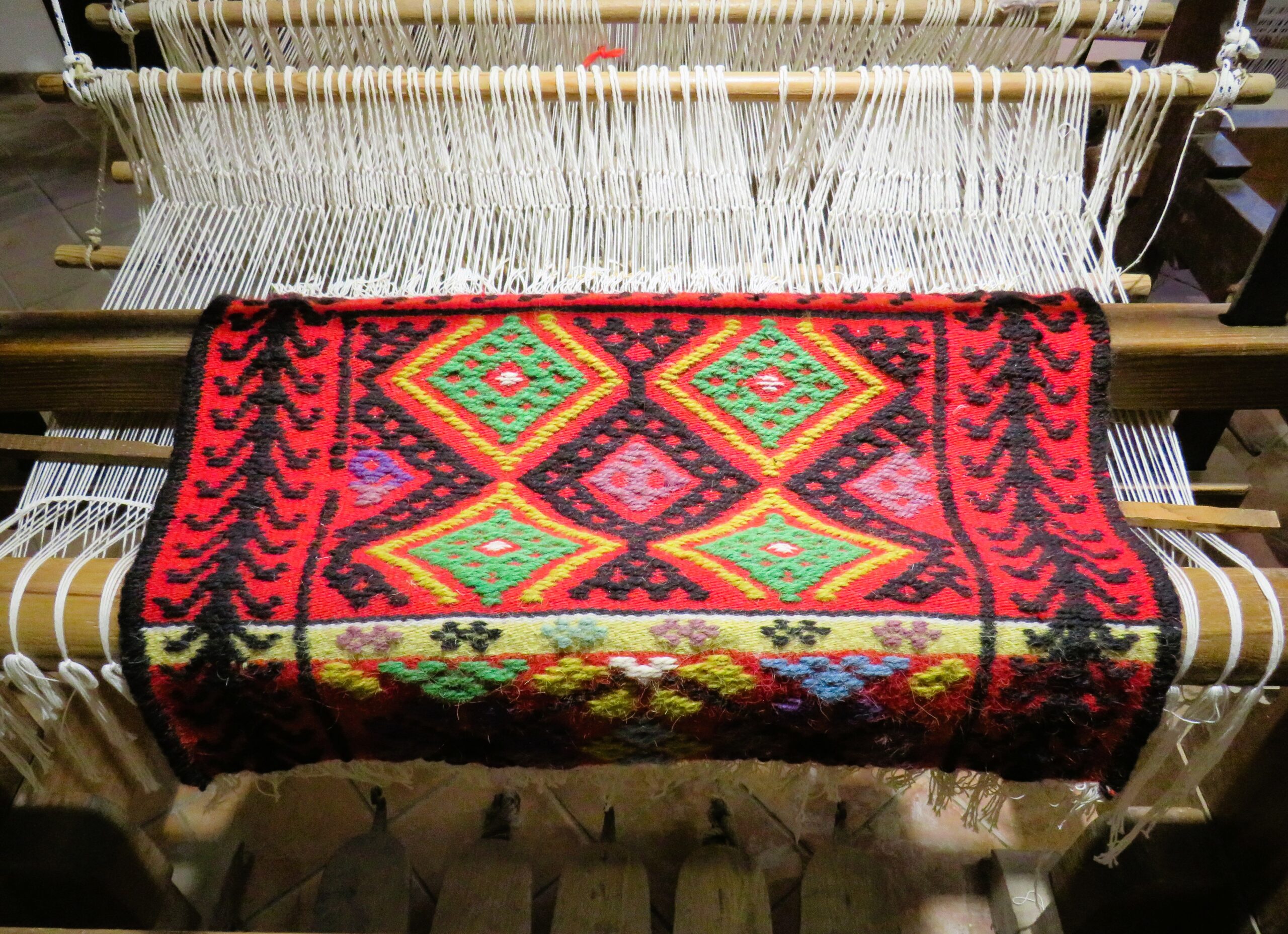
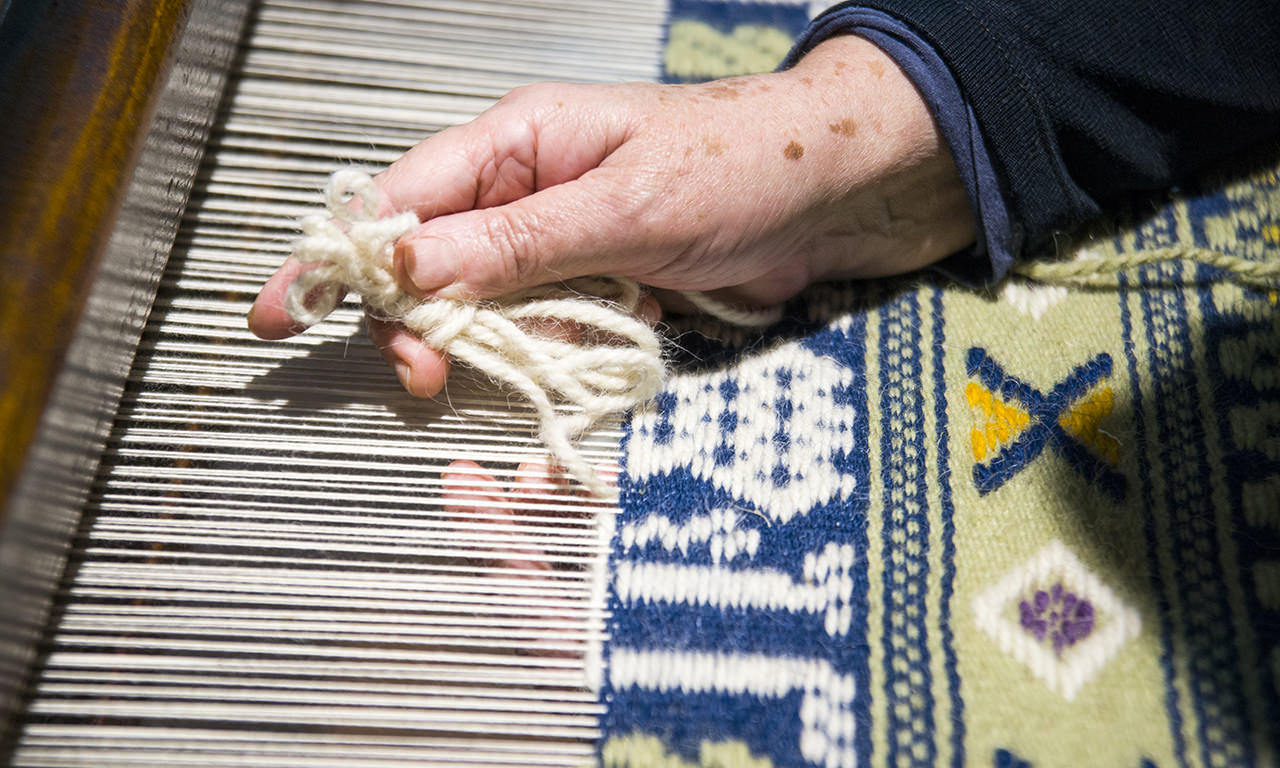
 The production of Aggius carpets has been a vital economic resource since the 19th century. In 1927, Prof. Cannas founded the first weaving school to preserve this precious tradition. Local artisan workshops have continued to produce these carpets without interruption, passing down the art from generation to generation.
Aggius carpets are renowned for their vibrant colors and distinctive decorations, creating a sort of “textile painting”. The traditional colors used are yellow, red, natural black, purple, green, light blue, burgundy, white, and gray.
In Aggius, two types of weaving are practiced: the “soprariccio”, known in the rest of Sardinia as “pibiones”, which uses a loom with four heddles and four pedals, and the “a l’antiga” technique, with two heddles and two pedals. The warp is made of cotton. The weaving style, known as “a dati”, is characterized by a series of horizontal stripes separated by bands of different colors, called “pommu”.
Among the other main types of carpets, we find “lu saccu a ciai”, considered the simplest carpet, formerly used as a blanket, and the carpet with continuous design. The carpets are made of linen and carded wool. The combination of traditional materials and techniques makes each carpet unique, celebrating the rich cultural and artistic heritage of Aggius, appreciated both in Sardinia and abroad.
 Traditional clothing represents one of the most effective symbols of cultural belonging, capable of clearly delineating collective, regional, and national identities. In the context of traditions, clothing had a social communication function, making immediately recognizable the region of origin, sex, age, marital status, and role of each community member.
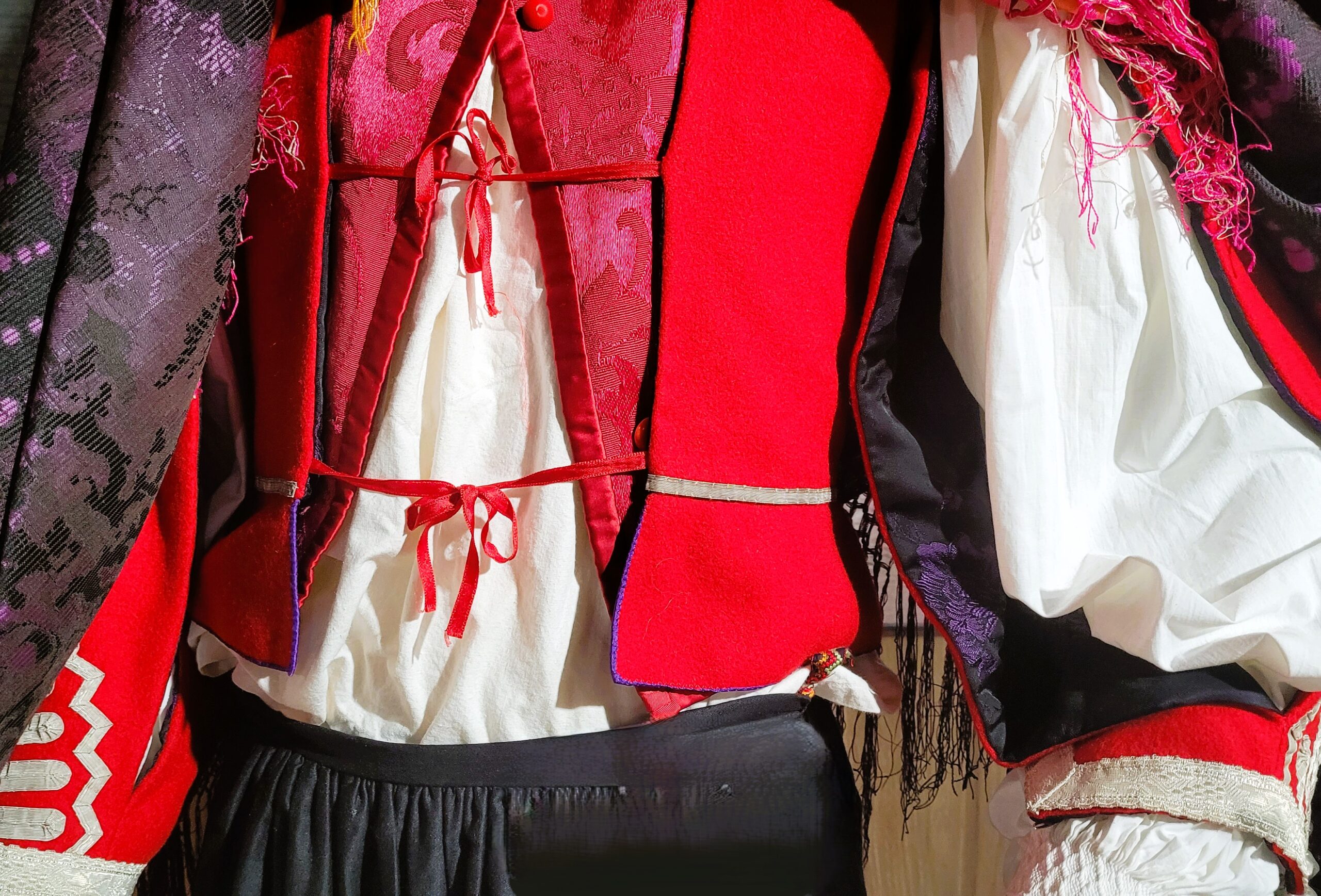
A significant example is the “camisgiòla” or little jacket, a female garment specially prepared for marriage and subsequently used on all occasions that required elegant attire.
The camisgiòla was made with heavy fabrics such as orbace, cloth, and velvet (strictly red in color), enriched with silver lace and lined with high-quality brocade.
The front part of the jacket was reduced to highlight the shirt and bodice and was closed with two laces, while the sleeves, long to the wrist, had large longitudinal openings from the armpit to the forearm, through which the wide sleeves of the shirts protruded. On the outer part of the sleeves, along the forearm, fake buttonholes were sewn from which ten burnished silver buttons hung. This detailed closure system not only added a decorative element to the garment but also reflected the craftsmanship and attention to detail characteristic of traditional clothing.



 e poi
e poi